In most translation, using a few different words for the same idea is a sign of good style. In patent translation, it can quietly undermine the very rights the document is meant to protect. Terminology consistency isn’t a stylistic preference in patent work—it’s a requirement. Here’s why.
In patents, the same thing must always have the same name
A patent specification refers to the same component again and again—in the claims, the detailed description, the summary, and the drawings. For the document to hold together, that component must be called by exactly the same name every time.
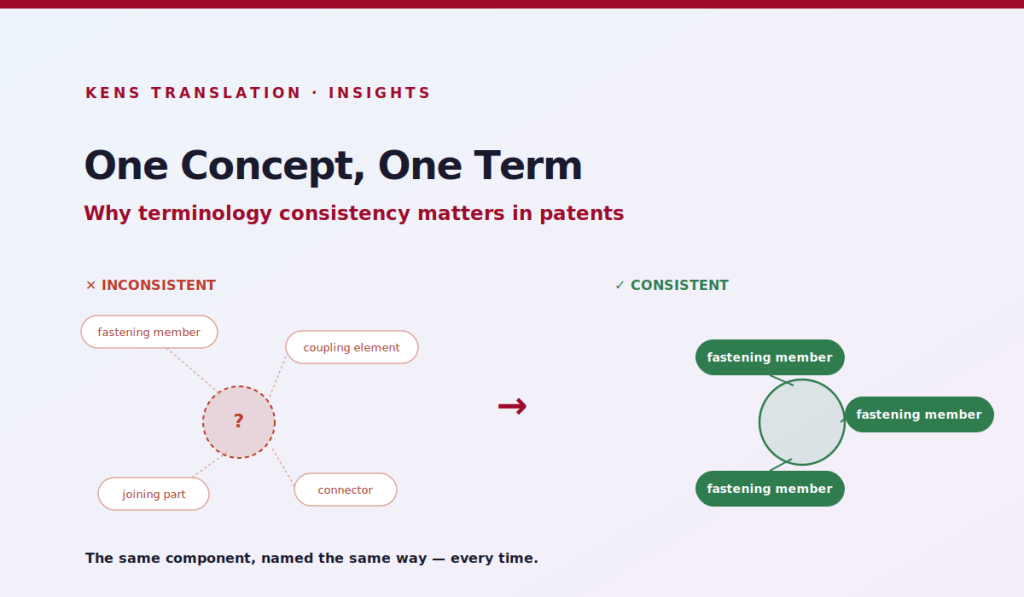
If a part is called a “fastening member” in the claims but a “coupling element” in the description, a reader—or an examiner—may reasonably ask: are these the same thing, or two different things? In ordinary writing, that variation reads as richness. In a patent, it creates doubt about what the claims actually cover.
Inconsistency can narrow—or cloud—your rights
This is more than a matter of tidiness. When terminology drifts, the scope of protection becomes harder to defend. An examiner may raise a clarity objection. An opponent in litigation may argue that an inconsistently used term is indefinite, or that the claims and description don’t correspond. What began as a small wording choice can become a genuine vulnerability in the patent.
The danger is amplified in translation. A source document may use one consistent term throughout, but if the translator renders it differently in different places—each rendering perfectly accurate on its own—the consistency is lost in the target language. The translation reads fluently, yet the unity of the original quietly disappears.
How careful translators protect consistency
This is why experienced patent translators don’t simply translate sentence by sentence. Before and during the work, they build a terminology reference for the document, mapping each key term to a single, fixed rendering. Every time that term appears, the same translation is used—deliberately, not by chance.
The review stage reinforces this. Checking the translation against the source, line by line, catches the places where a term may have slipped into a synonym, and brings them back into alignment. It is unglamorous work, but it is exactly what keeps a patent’s rights intact across a language boundary.
Consistency is part of protecting the invention
In the end, terminology consistency is not about elegance. It is about making sure that what the inventor claimed in one language remains exactly what they claim in another—no broader, no narrower, no more ambiguous.
At Kens Translation, we treat terminology discipline as a core part of the work, not an afterthought. Every document is handled by specialists who understand the technology and the law, and reviewed against its source so that a single concept never fractures into several. Because in patents, consistency is not a detail—it is part of protecting the invention itself.
We believe accuracy and reasonable pricing don’t have to be a trade-off. If you have a patent that needs to be translated with its terminology—and its rights—kept intact, we would be glad to help. Please feel free to reach out by email anytime.
Kens Translation
Patent · Legal · Technical Translation | Korean · English · Chinese · Japanese
📧 kens@kens-trans.com | ☎ +82-2-2645-5888 | 🌐 www.kens-trans.com


Leave a comment