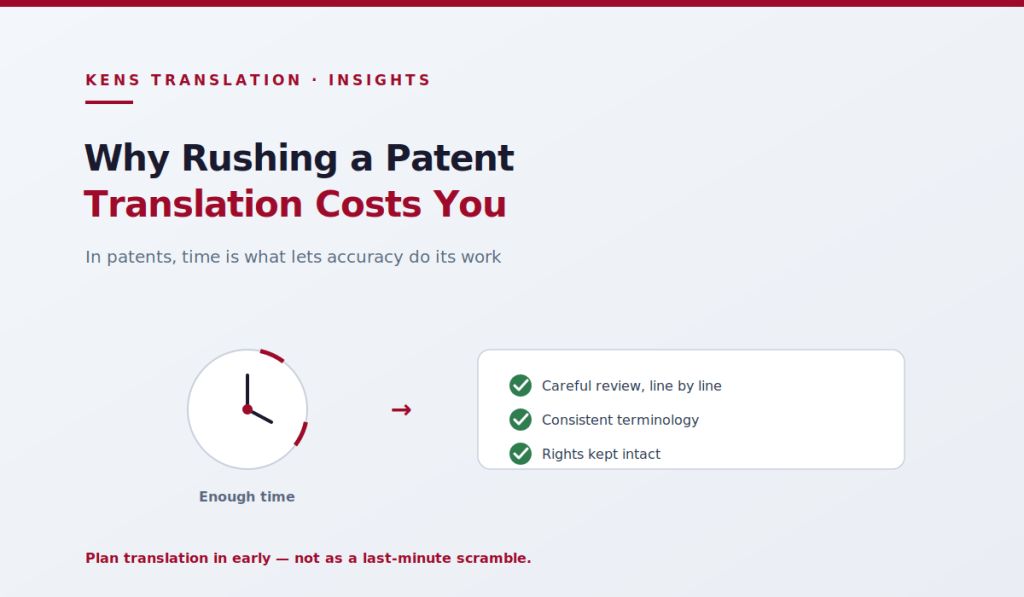
When a filing deadline looms, it’s tempting to ask for a patent translation “as fast as possible.” That’s understandable—deadlines are real, and they don’t move. But in patent translation, time and quality are more closely linked than many expect. Here’s why a rushed translation can carry hidden costs.
Patent translation isn’t a race
Translating a patent isn’t simply converting words at speed. A translator first has to understand the invention, map out the terminology, and work through how each claim defines the scope of protection. Then the draft is reviewed against the source, line by line, to catch omissions, inconsistencies, and anything that might narrow a right.
Each of these steps takes time—not because anyone is slow, but because that is what accuracy requires. Compress the schedule too far, and the first things to suffer are exactly the steps that protect your rights.
What gets lost when time runs short
Under extreme time pressure, the review stage is usually the first casualty. Yet review is where a fresh eye catches the term that drifted into a synonym, the claim element that lost its connection, the number that was transposed. Skip or shorten it, and small errors slip through—errors that read smoothly but can weaken a claim.
Terminology consistency also suffers. Building and applying a consistent set of terms across a long specification takes care. Rush it, and the same component may end up with two different names—an ambiguity that can surface later in examination or dispute.
Fast and accurate isn’t impossible—with the right setup
None of this means urgent work can’t be done well. It can—when the team is experienced, the terminology is already managed, and the process is built for it. A specialist who knows the field can move efficiently without cutting the steps that matter.
The key is honesty about timing. When you share a realistic deadline—and flag which parts are the true priority, usually the claims—a good translation partner can plan the work so the most critical sections get the attention they need.
Planning ahead is the real advantage
The best way to avoid a rushed translation is to bring it into the timeline early. Treating translation as a final afterthought, squeezed into the last days before a deadline, is where risk creeps in. Factoring it in from the start turns translation from a last-minute scramble into a dependable step.
In closing
In patent translation, speed and quality aren’t enemies—but time is what allows accuracy to do its work. A translation given room to be done right is one that protects the rights it carries.
At Kens Translation, we work with you on realistic timelines so that accuracy is never the casualty of a deadline. If you have a filing on the horizon, reach out early—we’re glad to help you plan.
Kens Translation
Patent · Legal · Technical Translation | Korean · English · Chinese · Japanese
📧 kens@kens-trans.com | ☎ +82-2-2645-5888 | 🌐 www.kens-trans.com
 Kens Translation
Leave a comment