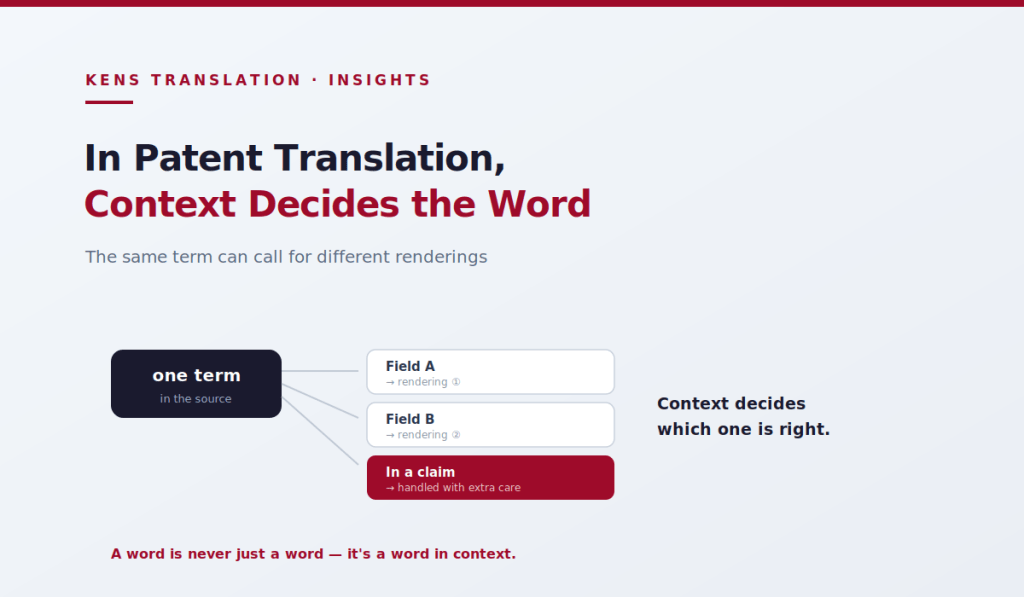
Here’s something that surprises people new to patent translation: the “right” translation of a word often can’t be decided by the word alone. The same term can call for different renderings depending on the context around it—and getting that judgment right is at the heart of accurate patent translation.
One word, several possible translations
Technical terms rarely map one-to-one across languages. A single word in the source may have several plausible equivalents in the target language, each correct in some settings and wrong in others. Which one fits depends on the surrounding technology, the structure of the claim, and how the term functions within the invention.
Pick the dictionary’s first entry without weighing the context, and you may get a sentence that reads fine but describes something subtly different from what the inventor meant.
The same term can shift with the field
Consider a term used across several industries. In one technical field it may carry one meaning; in another, something quite different. A translator has to recognize which field the specification belongs to and choose the term that field actually uses—not simply the most common or literal option.
This is one reason patent translation benefits from field-specific expertise. Someone who understands the technology can read the context and land on the term that fits, rather than a generic equivalent.
Context also lives in the claims
In patents, context isn’t only about technology—it’s also about how a term functions within the claim structure. A word tied to the scope of a right has to be handled with that role in mind. The same expression might be rendered one way in the detailed description and require special care in a claim, where its effect on the scope of protection is direct.
Reading a term in isolation misses this. Reading it in context—within the claim, within the invention—is what allows a translator to preserve the intended meaning.
Which is why translators read before they translate
This is why an experienced patent translator reads and understands the whole document before rendering a single line. Only by grasping the full context can they make the many small, context-dependent choices that add up to an accurate translation.
In closing
In patent translation, a word is never just a word—it’s a word in context. Understanding that context is what turns a literal rendering into an accurate one that protects the rights the specification was written to secure.
At Kens Translation, our specialists translate with the full context in view—technology, claim structure, and intent alike. Whenever you need patent translation done right, we’re glad to help.
Kens Translation
Patent · Legal · Technical Translation | Korean · English · Chinese · Japanese
📧 kens@kens-trans.com | ☎ +82-2-2645-5888 | 🌐 www.kens-trans.com
 Kens Translation
Leave a comment