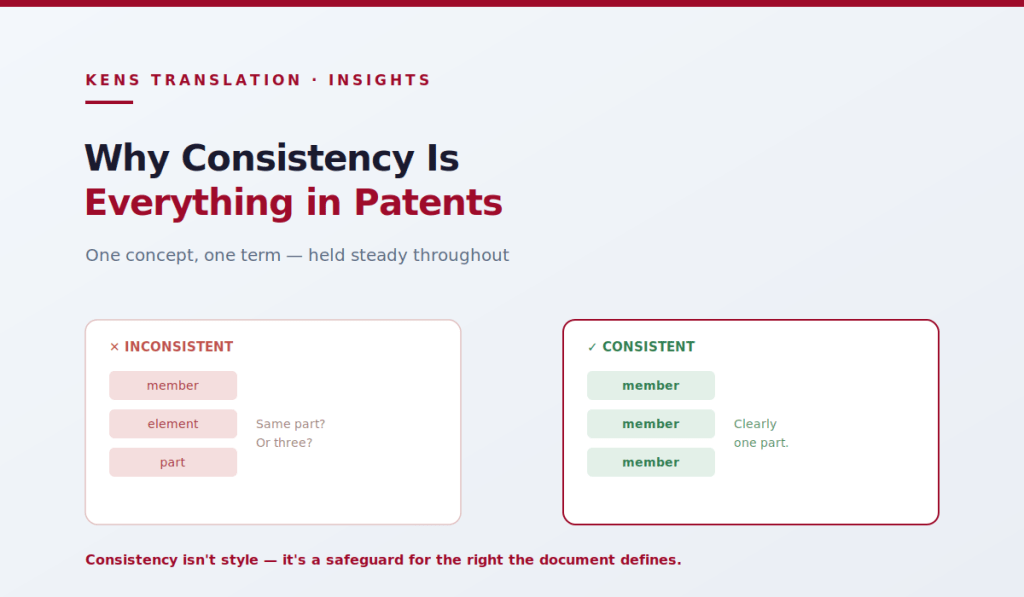
In most writing, variety is a virtue. Using different words for the same idea keeps prose from feeling repetitive. In patent translation, the opposite is true—consistency isn’t just preferred, it’s essential. Here’s why.
One component, one term—from start to finish
A patent specification refers to the same component many times across claims, description, and drawings. In everyday writing, calling it a “member” in one place and an “element” in another would simply read as stylistic variety. In a patent, it can create genuine ambiguity: are these the same part, or two different ones?
That ambiguity matters because a patent defines a right. If a reader—an examiner, an attorney, a court—can’t be certain that two words refer to the same thing, the scope of protection becomes harder to pin down. So in patent translation, one component should carry one term, held steady from the first page to the last.
Consistency across a whole portfolio
Consistency isn’t only about a single document. Companies often file many related patents over time, and terms used in earlier filings ideally carry through to later ones. A term translated one way in a first application and differently in a continuation can create confusion across a portfolio.
This is why experienced patent translators build and maintain terminology records—so the same source term is rendered the same way, not just within a document, but across a body of related work.
Why it takes deliberate effort
Maintaining consistency across a long, complex specification isn’t automatic. Over dozens of pages, it’s easy for a synonym to slip in, especially when a term has several plausible translations. Keeping them uniform takes attention and a systematic approach—tracking each key term and applying it consistently throughout.
This is quiet, behind-the-scenes work. It rarely draws attention, but it’s part of what separates a translation that reads as one coherent document from one that subtly undermines itself.
In closing
In patent translation, consistency isn’t a stylistic preference—it’s a safeguard for the right the document defines. One concept, one term, held steady throughout: it sounds simple, but it takes real care to achieve.
At Kens Translation, we treat terminology consistency as a core part of quality. We manage key terms deliberately and check them through careful review, so a specification reads as the single, coherent document it needs to be. If you’re preparing a patent filing, we’d be glad to help.
Kens Translation
Patent · Legal · Technical Translation | Korean · English · Chinese · Japanese
📧 kens@kens-trans.com | ☎ +82-2-2645-5888 | 🌐 www.kens-trans.com
 Kens Translation
Leave a comment