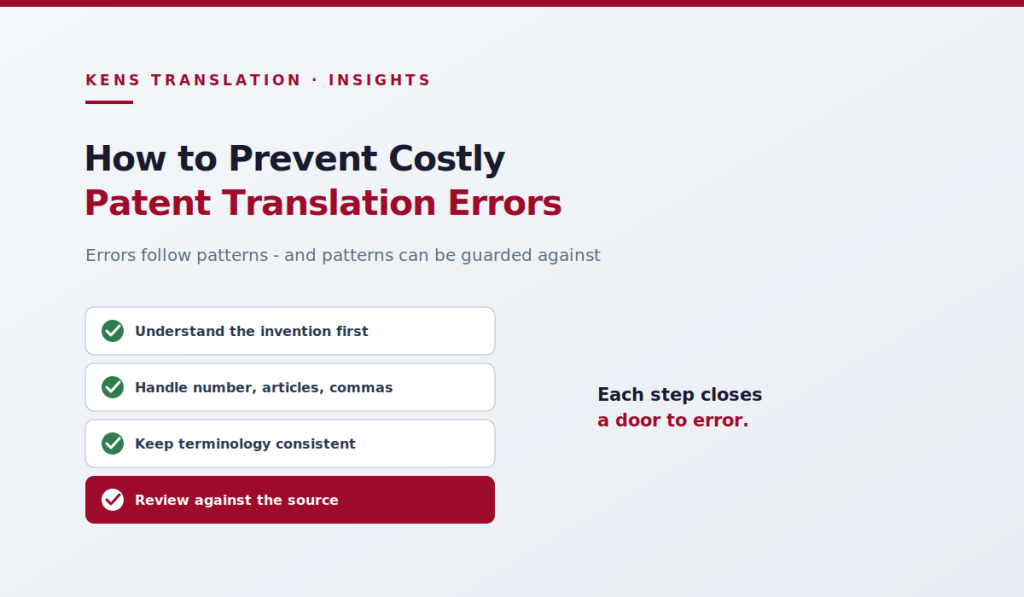
Stories of patents lost to a single mistranslated word make for cautionary reading—but the more useful question is: how do you prevent them? Errors in patent translation aren’t a matter of bad luck; they follow patterns, and those patterns can be guarded against. Here’s how careful patent translation avoids the traps.
Understand the invention before translating
Many translation errors trace back to a single root cause: translating words without fully grasping the invention. A translator who understands what the invention does, and how each claim element functions, is far less likely to narrow or distort a right by accident.
That’s why strong patent translation begins not with translating, but with reading—understanding the technology and the structure of the claims before a single line is rendered.
Handle number, articles, and punctuation with care
Many famous patent translation errors come down to small grammatical choices: singular versus plural, the presence or absence of an article, the placement of a comma. In ordinary text these are minor. In a claim, they can shift the scope of protection.
Preventing these errors means treating each such choice as a decision, not an afterthought—weighing how it affects meaning in the target language, rather than defaulting to whatever reads most naturally.
Keep terminology consistent
Inconsistent terminology is a quieter but equally serious source of trouble. When the same component is rendered several different ways, ambiguity creeps in—and ambiguity in a patent is risk. Preventing it takes a deliberate approach: identifying key terms and applying them consistently from the first page to the last.
Review against the source
Perhaps the most important safeguard is review. Even a skilled translator benefits from a second specialist comparing the translation against the source, line by line—catching the dropped qualifier, the drifted term, the number that slipped. Most preventable errors are caught precisely here, which is why review isn’t optional.
In closing
Costly patent translation errors aren’t inevitable. They’re prevented by understanding the invention, handling small grammatical choices with care, keeping terminology consistent, and reviewing rigorously against the source. Each step closes a door that errors would otherwise walk through.
At Kens Translation, these safeguards are built into how we work—specialists who understand the technology, careful attention to detail, and thorough review. If you want your patent translated with these protections in place, we’d be glad to help.
Kens Translation
Patent · Legal · Technical Translation | Korean · English · Chinese · Japanese
📧 kens@kens-trans.com | ☎ +82-2-2645-5888 | 🌐 www.kens-trans.com
 Kens Translation
Leave a comment