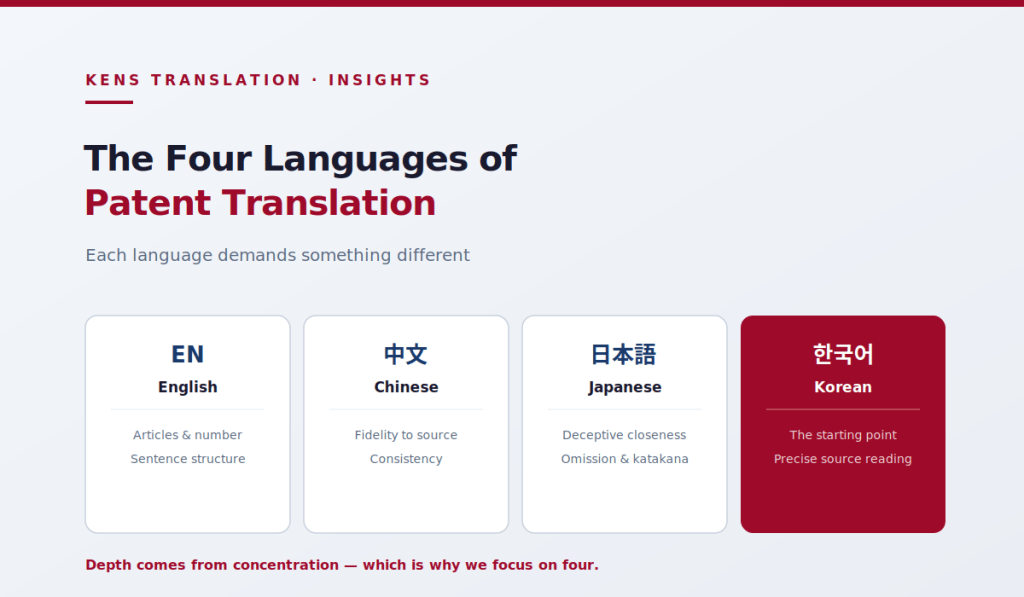
Kens Translation focuses on four languages—Korean, English, Chinese, and Japanese. Not because there aren’t others worth doing, but because patent translation demands depth, and depth comes from concentration. Each of these languages presents its own distinct challenges. Here’s a look at what each one demands.
English: articles and number
English has features Korean lacks entirely—articles (“a,” “an,” “the”) and strict singular/plural distinctions. In a patent claim, whether a component is “a member” or “the member,” singular or plural, can affect how the claim is read. Rendering these requires understanding the invention well enough to choose correctly, since the source Korean offers no direct guide.
English also restructures long sentences. Korean builds meaning toward the end of a sentence; English distributes it differently. A long claim rendered in the original order can turn ambiguous, so the logical structure has to be rebuilt while staying within the meaning of the original.
Chinese: fidelity and consistency
For filings in China, the Chinese translation often becomes the legal basis of the right itself. That raises the stakes on fidelity: the translation must stay within the scope of the original, since adding matter beyond it can create problems that are difficult to correct later.
Chinese patent examination also places weight on consistency—the same component rendered with the same term throughout, and terminology aligned between claims, description, and drawings. Handling the precise wording of claims, where similar-looking terms can carry different weight, calls for real familiarity with Chinese patent practice.
Japanese: closeness that deceives
Japanese shares Korean’s word order and much of its Chinese-character vocabulary, which makes it feel easy—and that’s the trap. Shared characters can carry subtly different meanings; the frequent omission of subjects and objects demands careful judgment about whether to supply them or preserve the source structure; and katakana loanwords must be traced back to their original terms.
Korean: the starting point
For all of these, Korean is often the origin. Understanding the source precisely—its technology, its intent, the scope its claims define—is the foundation everything else rests on. A translation is only as accurate as the reading of the original behind it.
Why concentration matters
Each language demands something different, and knowing those differences is what makes accurate translation possible. This is why Kens concentrates on four languages rather than spreading across many. The expertise required—language, technology, and patent practice together—grows deeper with focus, not wider with breadth.
In closing
Four languages, four sets of demands. English asks for precision with articles and number; Chinese for fidelity and consistency; Japanese for vigilance against deceptive closeness; Korean for a precise reading of the source. Understanding what each requires is what turns translation into protection of a right.
At Kens Translation, this is exactly where we concentrate our expertise. If you have a patent to translate in any of these languages, we’d be glad to help.
Kens Translation
Patent · Legal · Technical Translation | Korean · English · Chinese · Japanese
📧 kens@kens-trans.com | ☎ +82-2-2645-5888 | 🌐 www.kens-trans.com
 Kens Translation
Leave a comment