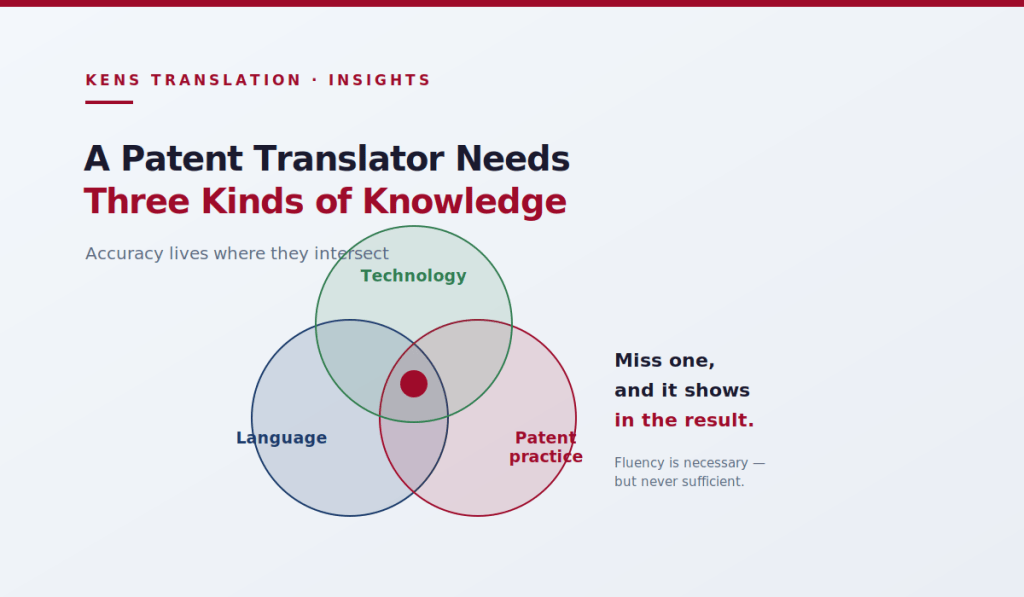
We tend to think of translation as a language skill. And it is—but patent translation sits at an unusual intersection. To render a patent accurately, a translator has to draw on three different kinds of knowledge at once: language, technology, and patent practice. Missing any one of them shows in the result. Here’s why all three matter.
Language: the foundation, but only the foundation
Language ability is where it starts. A patent translator needs full command of both the source and target languages—not just vocabulary and grammar, but how meaning is built and how nuance shifts between them.
Yet language alone isn’t enough. A translator fluent in two languages but unfamiliar with the technology or the conventions of patents can produce text that reads smoothly while misstating the invention or weakening a right. Fluency is necessary, not sufficient.
Technology: understanding what’s being described
The second kind of knowledge is technical. A patent describes an invention, and to translate it faithfully, the translator has to understand what that invention actually does—how its components relate, what each step accomplishes.
Without this, a translator may pick a dictionary-correct term that no one in the field uses, or miss when a rendering subtly distorts how the technology works. Understanding the technology is what lets a translator choose the right term among several and recognize when something has gone wrong.
Patent practice: knowing how rights work
The third kind of knowledge is the most easily overlooked: an understanding of how patents work as legal instruments. A patent isn’t just a technical document—it defines a right, and its wording carries legal consequences.
A translator who understands patent practice knows that a small word can shape the scope of protection, that terminology must stay consistent for legal reasons, that fidelity to the source matters because added meaning can create problems later. This awareness shapes countless small decisions throughout a translation.
Where the three meet
What makes patent translation demanding is that these three kinds of knowledge have to work together, at the same time. A translator strong in language but weak in technology, or strong in both but unaware of patent practice, will miss things. The accuracy of a patent translation lives exactly where language, technology, and patent practice intersect.
In closing
Patent translation is often thought of as a language task, but it draws on three kinds of knowledge at once: language, technology, and patent practice. Each covers what the others can’t, and it’s their combination that protects the accuracy and the rights held in a patent.
At Kens Translation, this combination is what we build our work around—specialists who bring language, technical understanding, and patent knowledge together. If you’re looking for patent translation done where all three meet, we’d be glad to help.
Kens Translation
Patent · Legal · Technical Translation | Korean · English · Chinese · Japanese
📧 kens@kens-trans.com | ☎ +82-2-2645-5888 | 🌐 www.kens-trans.com
 Kens Translation
Leave a comment