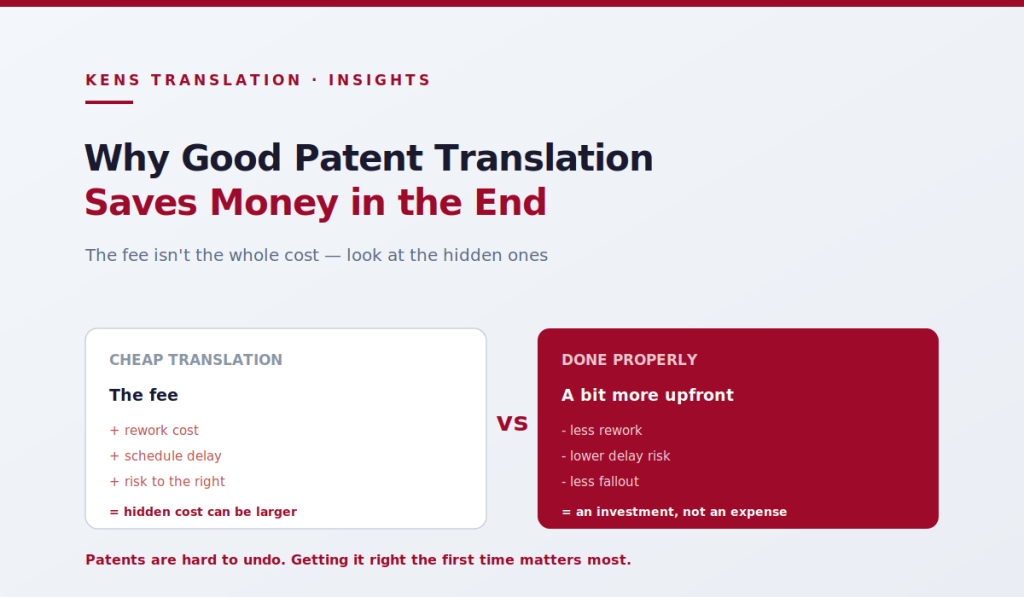
When commissioning a patent translation, cost is a real consideration. For the same document, it’s natural to look for somewhere a little cheaper. But in patent translation, the “cheap” option isn’t always the one that saves money. Often, it’s good translation that saves money in the end. Why? Here’s a look.
The real cost of patent translation isn’t just the fee
When we think about the cost of a patent translation, we usually look only at the translation fee itself. But patent translation carries hidden costs—the ones that follow when something goes wrong with the translation.
If a translation contains errors, finding and correcting them takes time and effort. If it becomes an issue during examination, responding can add cost. In the worst case, if a translation problem affects the right itself, the loss dwarfs the translation fee. The initial fee, in other words, is only part of the total cost.
The hidden cost of cheap translation
Sometimes choosing the cheapest option based on fee alone leads to a larger cost later. A prime example is rework. If translation quality falls short, you end up reviewing and revising it—or in serious cases, retranslating. By then, more time and money have gone in than you saved at the start.
On top of that, timing matters for patents. If you have to redo a translation while racing against a filing deadline, that delay itself becomes another cost. This is the moment a cheap translation turns out to be the expensive choice.
Good translation reduces the fallout
Done properly from the start, translation reduces these hidden costs. An accurately translated document leaves less room for problems downstream. There’s less rework, lower risk of schedule slippage, and examination tends to go more smoothly.
Of course, good translation may cost more upfront. But that’s less an “expense” than an investment in reducing fallout. For a document like a patent, which holds force as a right over a long period, doing it properly the first time is worth all the more.
Patents are especially hard to undo
With an ordinary document, discovering a mistake later is relatively easy to fix. Patents are different. Once filed and registered, the content is hard to change freely—especially where it affects the scope of the right.
Because of this difficulty in undoing, patent translation is a place where getting it right the first time especially matters. “We can fix it later” doesn’t really apply here.
In closing
Spending wisely on patent translation isn’t simply about finding the cheapest option. It’s about considering the fee together with the hidden costs, and making the most sensible choice overall. Good translation goes beyond the immediate fee to reduce rework, delay, and even risk to the right. So in the end, proper translation can be the way to save money.
At Kens Translation, we aim for translation done properly from the start—reducing the costs and risks that follow through accuracy. That’s what we consider truly “sensible” translation. If you need patent translation, we’d be glad to help.
Kens Translation
Patent · Legal · Technical Translation | Korean · English · Chinese · Japanese
📧 kens@kens-trans.com | ☎ +82-2-2645-5888 | 🌐 www.kens-trans.com
 Kens Translation
Leave a comment