Sometimes a patent translation simply has to be done fast—a deadline appears, and there’s no room to move it. Good providers can handle urgent work. But it’s worth understanding what actually happens when a patent translation is rushed, so you can weigh the trade-offs and, where possible, avoid the risks. Here’s a look at what rushing puts at stake.
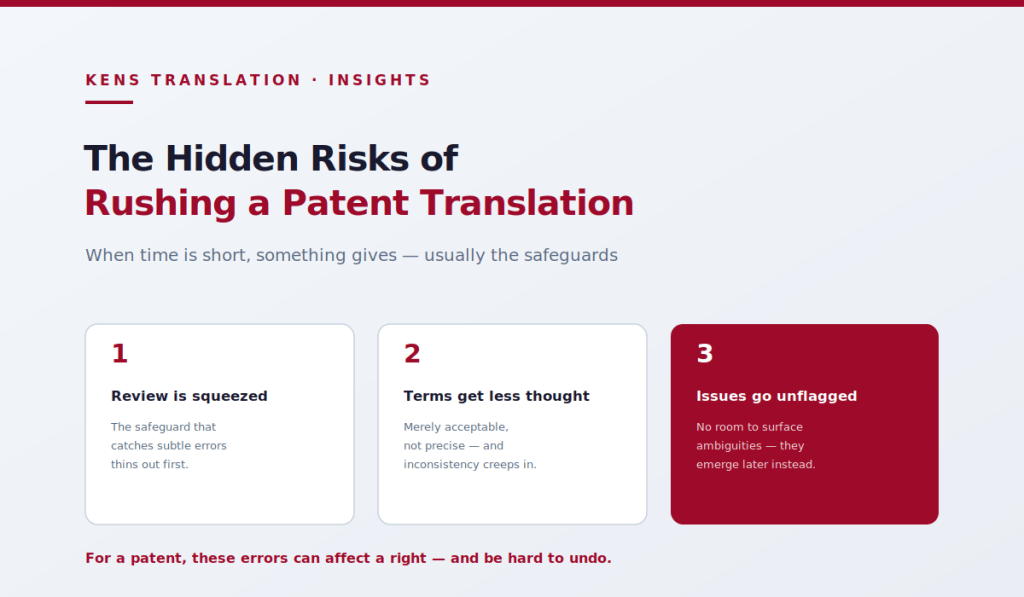
The review step is the first to be squeezed
When time is short, something has to give—and it’s usually review. A rushed schedule tends to preserve the translation itself while compressing or shortening the step where someone checks the translation against the original.
But review is exactly where subtle errors get caught—inconsistent terms, small omissions, a qualifier lost along the way. Squeeze that step, and the very safeguard that protects a patent’s accuracy is the thing that thins out first.
Terminology decisions get less consideration
Choosing the right term in a patent isn’t instant. It often means checking how a term is actually used in the field, weighing options, and settling on one that fits the invention. Under time pressure, these decisions get made faster and with less deliberation.
The result can be terminology that’s merely acceptable rather than precise, or inconsistency that creeps in when there’s no time to reconcile choices across a long document.
Less room to catch and flag issues
A careful patent translation surfaces things worth a second look—an ambiguous passage in the original, an apparent error, a point where a judgment call was made. Bringing these to attention takes time and attention that a rushed job may not allow.
When there’s no room to flag such points, they can pass silently—and a problem that could have been caught early may only surface much later, when it’s harder to address.
Why this matters more for patents
For many documents, a rushed translation just reads a little rougher. For a patent, the stakes are higher. A patent defines a right, and the errors that slip through under time pressure can affect that right—sometimes in ways that are difficult to undo once the document is filed.
This is why, whenever possible, giving a patent translation enough time isn’t a luxury. It’s a way of protecting what the document is meant to secure.
In closing
Rushing a patent translation puts real things at risk: the review step, terminology decisions, and the chance to catch and flag issues. Skilled providers can still do urgent work well, but the safest path is to allow enough time whenever you can. Understanding these risks helps you plan so that speed doesn’t come at the cost of accuracy.
At Kens Translation, we handle both urgent and unhurried work—but we’ll always help you plan so that time works in your favor. If you have a patent translation on the horizon, we’d be glad to help you prepare. Feel free to reach out anytime.
Kens Translation
Patent · Legal · Technical Translation | Korean · English · Chinese · Japanese
📧 kens@kens-trans.com | ☎ +82-2-2645-5888 | 🌐 www.kens-trans.com
 Kens Translation
Leave a comment