Continuing our look at the parts of a patent specification, this time we turn to the background section. It sets the stage for an invention by describing the prior state of the technology—and translating it calls for a particular kind of care. Here’s what to watch for.
What the background section does
The background section describes the technical context an invention arises from—the existing technology, and often the problems or limitations the invention aims to address. It’s the setup that helps a reader understand why the invention matters and what gap it fills.
In a sense, the background frames the invention. It doesn’t define the right the way the claims do, but it shapes how the invention is understood against what came before.
Preserve the framing, don’t reshape it
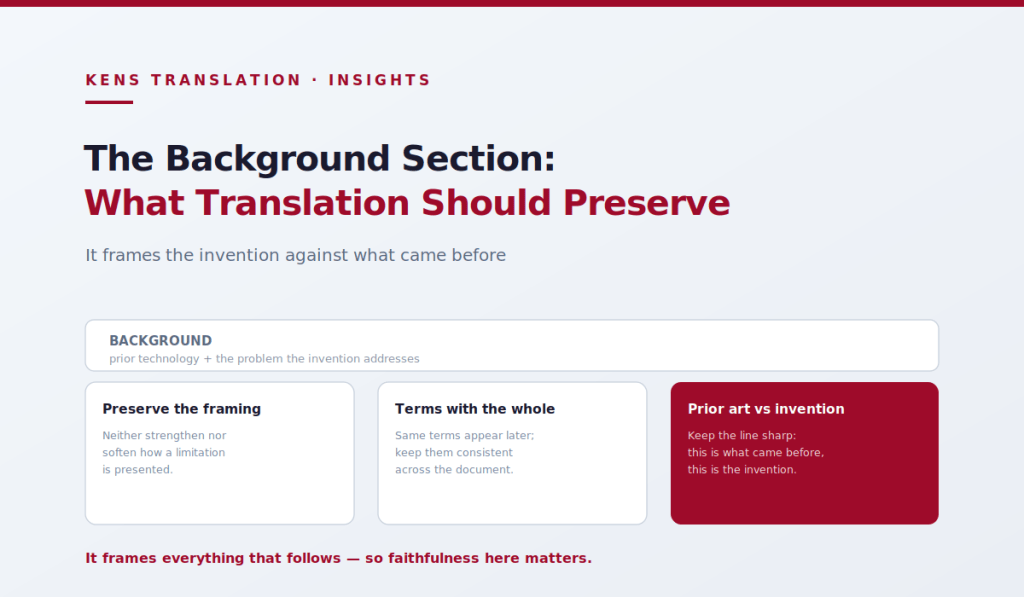
Because the background describes prior technology and its limitations, the way it’s framed matters. A translation should preserve that framing rather than reshaping it. If the original presents a limitation in a certain way, the translation should carry that across faithfully—neither strengthening nor softening it.
Reshaping the framing, even with good intentions, can subtly change how the invention is positioned against prior technology. Faithfulness to the original’s framing is what keeps that positioning intact.
Watch the terminology against the rest
Like other parts of the specification, the background introduces terms—often the same ones that appear later in the detailed description and the claims. Keeping these consistent from the background through the rest of the document matters.
A term rendered one way in the background and differently later can create ambiguity about whether the same thing is meant. So the background, too, has to be translated in step with the whole specification, not in isolation.
Distinguish prior art from the invention
One subtle but important point: the background often describes prior technology, not the invention itself. A translation needs to preserve that distinction clearly. If the framing blurs the line between what came before and what the invention contributes, it can create confusion about what is actually being claimed.
Keeping this boundary sharp—this is prior technology, this is the invention—is part of translating the background carefully.
In closing
The background section sets the stage for an invention, and translating it means preserving its framing, keeping terminology consistent with the whole, and maintaining the distinction between prior technology and the invention. It’s the part that frames everything that follows, so faithfulness here matters.
At Kens Translation, we translate each part of a specification with its role in mind—including the background, rendered faithfully and in step with the whole. If you need patent translation, we’d be glad to help.
Kens Translation
Patent · Legal · Technical Translation | Korean · English · Chinese · Japanese
📧 kens@kens-trans.com | ☎ +82-2-2645-5888 | 🌐 www.kens-trans.com


Leave a Reply