Continuing through the parts of a patent specification, this time we look at the drawings and their reference numerals. These might seem like the part where translation matters least—after all, a diagram is a diagram. But the labels, numerals, and descriptions tied to the drawings carry real weight, and handling them calls for a specific kind of care. Here’s what to watch for.
What drawings and reference numerals do
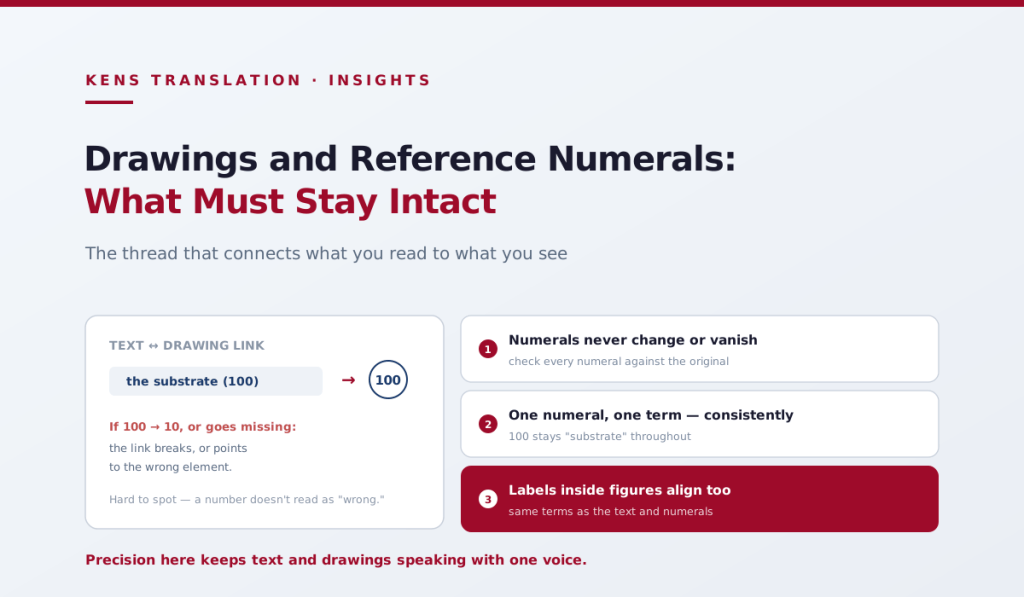
Drawings illustrate the invention visually, and reference numerals tie parts of those drawings to the terms used in the text. When the description says “the substrate (100),” that number 100 links the word “substrate” to a specific element in the figures.
This linking is what makes the drawings and the text work as one. The numerals are the thread that connects what you read to what you see.
Numerals must never change or go missing
The single most important rule: reference numerals must not change or disappear in translation. If “100” in the original becomes “10” or goes missing in the translation, the link between text and drawing breaks—or worse, points to the wrong element.
This is the kind of error that’s easy to make and hard to spot, because a number doesn’t read as “wrong” the way an awkward sentence does. Careful handling and checking of every numeral against the original is essential.
One numeral, one term—consistently
Each reference numeral should correspond to the same translated term throughout the document. If numeral 100 is “substrate” in one place, it shouldn’t become “board” or “base” elsewhere. Building a correspondence of numeral and term before translating, and applying it consistently, is what keeps the drawings and text aligned.
Where a single numeral is tied to more than one name in the original—or the reverse—that’s worth flagging for review before translation, so it can be sorted out rather than passed along inconsistently.
The labels within drawings matter too
Drawings often contain text labels of their own—short descriptions within the figures. These need to be translated consistently with the terms used in the body and the reference numerals. A label inside a figure that uses a different term from the text creates the same kind of confusion as any other inconsistency.
In closing
Drawings and reference numerals may look like the most mechanical part of a specification, but they’re what binds the text and the figures into one coherent whole. Numerals must stay exactly as they are, each tied consistently to one term, with labels aligned to the rest. Precision here is what keeps a patent’s text and drawings speaking with one voice.
At Kens Translation, we treat every part of a specification with the care its role demands—including the drawings and their numerals, kept intact and consistent. If you need patent translation, we’d be glad to help.
Kens Translation
Patent · Legal · Technical Translation | Korean · English · Chinese · Japanese
📧 kens@kens-trans.com | ☎ +82-2-2645-5888 | 🌐 www.kens-trans.com


Leave a Reply