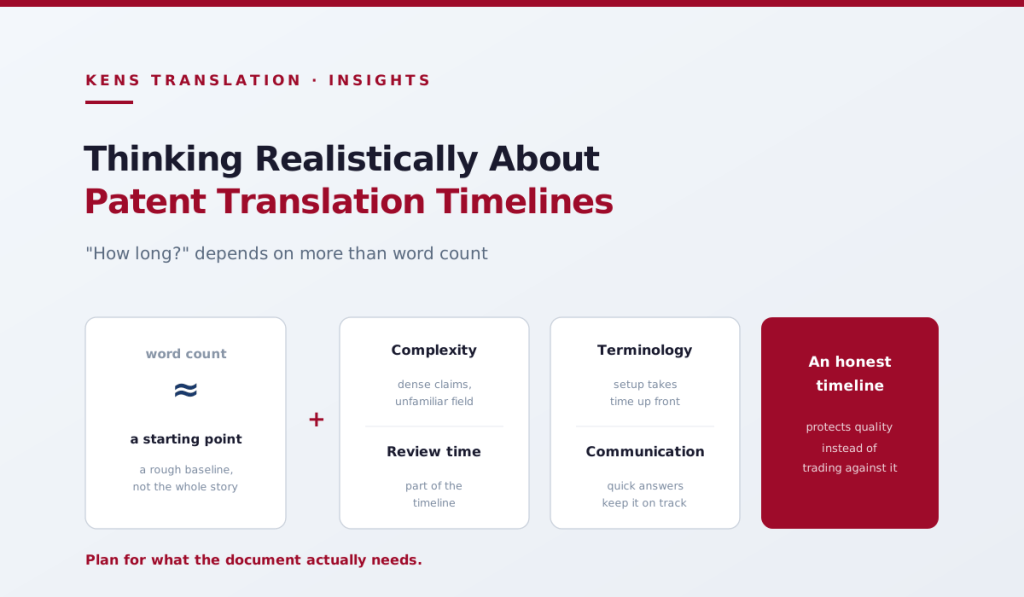
“How long will it take?” is one of the first questions clients ask about patent translation. It’s a fair question—but the honest answer is that it depends on more than word count. Understanding what actually shapes a timeline helps you plan better and avoid the pitfalls of an unrealistic schedule. Here’s a realistic look.
Word count is only the starting point
The length of a document is the obvious factor, and it does matter. But two patents of the same length can take very different amounts of time to translate well. A dense claims-heavy specification in an unfamiliar technical area takes longer than a straightforward one of equal length.
So while word count gives a rough baseline, it’s only a starting point. The nature of the content—its technical complexity, its density, how much terminology research it requires—shapes the real timeline just as much.
Review time is part of the timeline
A common mistake is to budget time for translation but forget about review. Yet review is an essential part of producing an accurate patent translation, and it takes time of its own. A realistic timeline accounts for both the translation and the step where it’s checked against the source.
When a schedule is compressed, review is usually the first thing to be squeezed—which is exactly the wrong thing to cut for a document where accuracy matters. Building review time into the plan from the start protects quality.
Terminology setup takes time up front
For a patent in a specialized field, or one connected to existing filings, setting up terminology properly takes time at the beginning. Checking how terms are used, aligning with related patents, building a consistent basis—this up-front work doesn’t show as “translation,” but it’s part of what the timeline needs to include.
This setup pays off later in speed and consistency, but it has to happen first. A timeline that skips it risks inconsistency that costs more time to fix down the line.
Communication affects the schedule too
A timeline also depends on how smoothly information flows. If questions arise during translation and answers come quickly, the work proceeds. If they wait, the schedule stretches. Having someone available to respond to questions—about an ambiguous passage or a terminology choice—keeps a timeline on track.
In closing
A realistic patent translation timeline accounts for more than word count: the complexity of the content, the review step, terminology setup, and smooth communication all shape how long good work takes. Understanding these factors helps you plan a schedule that protects quality rather than one that forces a trade-off against it.
At Kens Translation, we’ll give you an honest timeline based on what your document actually needs—and work with you to plan around it. If you have a patent translation coming up, we’d be glad to help you plan it realistically.
Kens Translation
Patent · Legal · Technical Translation | Korean · English · Chinese · Japanese
📧 kens@kens-trans.com | ☎ +82-2-2645-5888 | 🌐 www.kens-trans.com


Leave a Reply