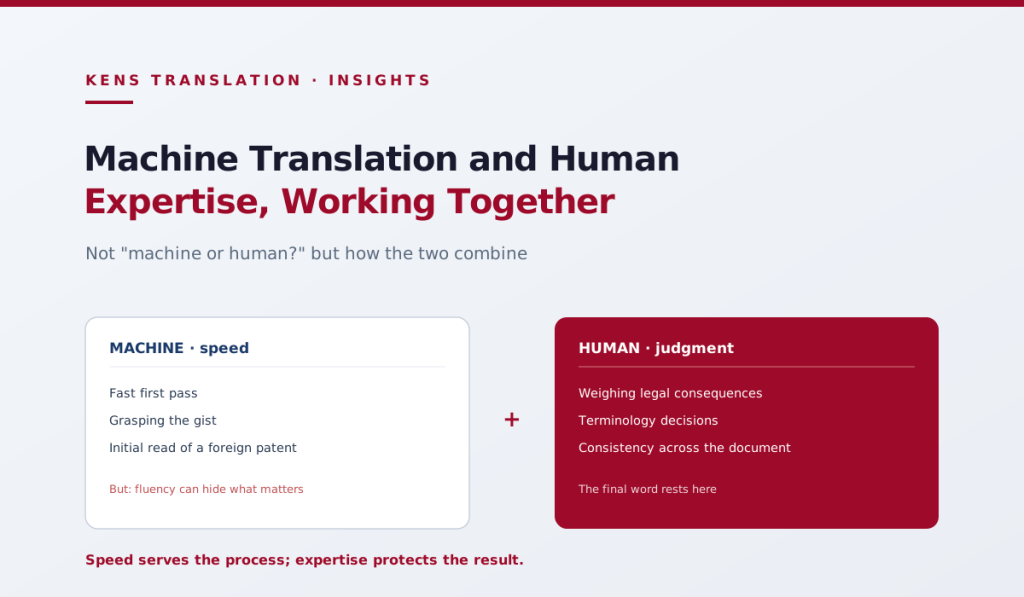
Machine translation isn’t something to simply reject or fully embrace. For patents, the useful question isn’t “machine or human?” but “how do the two work together best?” Understanding where each fits helps you get the benefits of speed without sacrificing the accuracy a patent demands. Here’s a look at how they combine.
Where machine translation genuinely helps
Modern machine translation is fast and, for getting the general sense of a document, genuinely useful. For an initial read of a foreign patent, or a rough first pass to understand what a document covers, it can save real time.
Used this way—as a tool for speed and for grasping the gist—machine translation has a legitimate place. The question is never whether the tool is useful, but where its usefulness ends.
Where human judgment becomes essential
The limits of machine translation show up precisely where patents are most demanding. A patent defines a right, and the subtle choices that shape that right—a qualifier that narrows a claim, two terms that look similar but carry different legal weight, terminology that must stay consistent across a long document—are matters of judgment.
This is where human expertise becomes essential. A specialist who understands the technology and how patents work can weigh these consequences in a way that fluent-sounding output cannot. The danger isn’t that machine translation reads badly; it’s that it reads well while missing what matters.
The risk of relying on fluency
The trap with machine translation in patents is its very fluency. Smooth output feels trustworthy, so errors hide in plain sight. A sentence that sounds right invites no scrutiny—even when it has quietly shifted the scope of a claim.
This is why machine output for a patent can’t simply be accepted as-is. The fluency that makes it useful for a quick read is the same quality that makes it risky as a final product.
Combining the two thoughtfully
The thoughtful approach uses each for what it does well. Machine translation can assist with speed and first drafts; human expertise carries the judgment, the terminology decisions, and the final responsibility for accuracy. What matters is that the final word rests with a specialist who understands what’s at stake—not with the tool.
Used together this way, with clear roles, the two aren’t in competition. The speed serves the process, and the expertise protects the result.
In closing
For patents, machine translation and human expertise aren’t an either-or choice. Machine translation offers speed and a useful first pass; human judgment protects the accuracy that a right depends on. Combining them thoughtfully—with the final responsibility resting on a person—is how you get the benefits of both.
At Kens Translation, accuracy always rests with specialists who understand both the technology and the law. If you want patent translation that uses tools wisely without compromising on accuracy, we’d be glad to help.
Kens Translation
Patent · Legal · Technical Translation | Korean · English · Chinese · Japanese
📧 kens@kens-trans.com | ☎ +82-2-2645-5888 | 🌐 www.kens-trans.com


Leave a Reply